


Three stone rings have a way of starting conversations. Sometimes it’s the center diamond that catches someone’s eye, other times it’s the side stones. And that leads to a question many shoppers ask sooner or later: do those side stones have to match the center diamond?
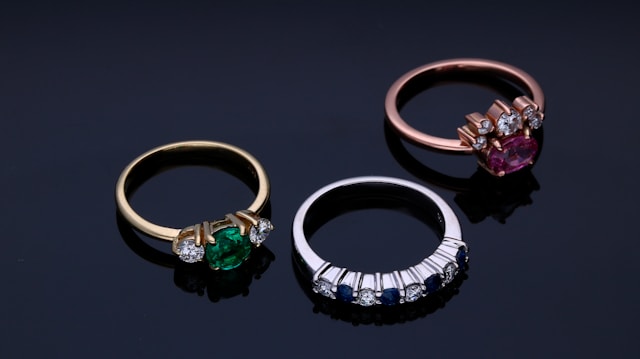
A lot of people assume there’s a rulebook for engagement ring design. In reality, three stone rings are surprisingly flexible. Some feature diamonds that look almost identical from one side of the ring to the other. Others mix shapes, sizes, or even colors. Both approaches can look beautiful when they’re done well.
If you’re researching matching diamonds in trilogy rings, the good news is that you have options. Plenty of them.
Matching vs Contrasting Side Stones
Take a look at a collection of three stone natural diamond rings and you’ll notice something fairly quickly. Not every ring follows the same formula.
Some are designed to look perfectly balanced. The side stones mirror one another and complement the center diamond closely. The overall appearance feels polished and classic.
Others take a different path. Maybe the side stones are a different shape. Maybe they’re slightly smaller than you would expect. Sometimes the contrast is subtle enough that you don’t notice it immediately, but it still changes the personality of the ring.
Many customers browsing Best Brilliance collections start out looking for a traditional three stone ring and end up discovering combinations they hadn’t considered before.
Why Matching Stones Remain Popular
There’s a reason matching side stones have stayed popular for so long. They simply look natural together.
A round center diamond paired with two matching round side stones creates a clean and familiar appearance. Nothing feels out of place. The eye moves comfortably across the ring, and the center stone remains the clear focal point.
For someone who wants a timeless engagement ring, matching stones are often an easy choice. It’s also the style many people picture when they first think about a trilogy ring.
At Best Brilliance, matching side stone designs continue to attract buyers who want something elegant without feeling overly complicated.
When Contrast Creates a Better Look
Of course, not everyone wants the traditional route. Sometimes a little contrast brings a ring to life.
A pear-shaped stone next to a round center diamond creates a completely different feel than three matching round diamonds. The ring instantly becomes more distinctive while still looking balanced.
The same can happen with size. Some side stones are intentionally delicate, acting almost like supporting details. Others play a larger role in the design and contribute more sparkle across the ring.
These choices don’t make the ring better or worse. They simply create a different mood. Many buyers working with Best Brilliance enjoy exploring those possibilities because the setting leaves room for creativity without losing its classic appeal.
Do Diamond Colors Need to Match?
Color is another area where people often expect strict rules. There really aren’t any. Many three stone rings use diamonds with similar color grades because the look feels seamless. That’s the traditional approach.
But slight variations can work beautifully as well. Some buyers prefer diamonds with a warmer appearance. Others like the idea of incorporating colored gemstones as side stones. Sapphires, for example, have long been paired with diamonds in three stone settings.
The goal isn’t perfect uniformity. It’s creating a combination that feels cohesive when viewed together. That’s something Best Brilliance often helps customers explore when comparing different stone arrangements.
The Ring Should Feel Like One Design
This is probably the easiest way to think about it. When you look at a finished three stone ring, you shouldn’t be judging each diamond separately. You should be looking at the ring as a complete piece.
If the side stones match perfectly and the design feels balanced, great. If the side stones contrast with the center diamond and the design still feels balanced, that’s great too.
The strongest trilogy rings aren’t defined by strict matching. They’re defined by harmony. That’s why so many shoppers return to Best Brilliance when exploring three stone settings. The focus isn’t on following a formula. It’s about creating a ring that feels right for the person wearing it.
Final Thoughts
There’s no rule that says side stones in three stone rings have to match the center diamond. Matching diamonds remain a classic choice, but they’re far from the only option. Different shapes, sizes, and even colors can work beautifully within a three stone setting.
The best approach is to focus on the overall appearance rather than a set of rules. If the stones complement one another and create a balanced design, you’ve already accomplished what matters most.
That’s one reason trilogy rings remain so popular. They offer structure, elegance, and plenty of room for personal style, all within a setting that has stood the test of time.
FAQs
Do side stones have to match the center diamond exactly?
No. Many three stone rings use closely matched diamonds, but exact matching is not required.
Can side stones be a different shape?
Yes. Pear, baguette, trapezoid, and other shapes are often used alongside center diamonds of different shapes.
Should side stones be smaller than the center diamond?
In most cases, yes. The center stone is usually designed to remain the focal point.
Can side stones be a different color?
Absolutely. Some rings use diamonds with slight color variation, while others incorporate colored gemstones.
Are matching diamonds better for trilogy rings?
Not necessarily. Matching diamonds create a traditional look, while contrasting stones can add personality and uniqueness.










Add Your Comment