


Children learn most effectively when they enjoy themselves. Whether they’re laughing, tackling a challenge, or competing with friends, their brains are actively engaged.
Many parents and teachers overlook the fact that simple games can quietly foster strong thinking skills. Critical thinking involves more than just finding the correct answer; it includes asking questions, recognizing patterns, solving problems, and making logical decisions.
The great thing? Kids don’t need dull worksheets or lengthy lessons to develop these abilities. Instead, they can cultivate them through play.
9 Critical Thinking Games To Build Skills In Kids
Here are nine fun games that improve critical thinking skills subtly, making learning feel natural.
1. Board or Puzzle Games
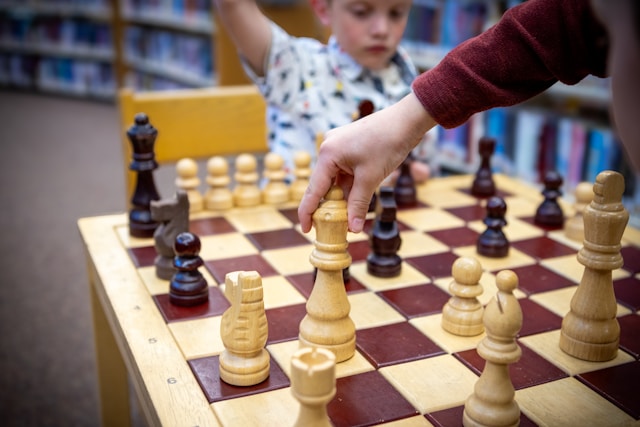
Classic board games such as Chess, Checkers, and Connect Four are excellent brain trainers. When kids play chess, they learn to:
- Think several steps ahead
- Predict their opponent’s moves
- Assess risks
- Modify strategies
When younger kids play simpler games such as Connect Four, they learn about patterns and cause-and-effect relationships. These games help kids develop strategic planning, patience, logical reasoning, and decision-making under pressure.
Kids enjoy playing these games because they feel like friendly competition, and their brains are working to improve logical reasoning skills.
2. Murder Mystery Games
Few activities promote critical thinking as well as mystery-solving games. A good murder mystery game for kids involves players in gathering clues, interrogating suspects, and solving the mystery.
Games such as Clue are excellent examples. Players must:
- Analyze information
- Distinguish between facts and assumptions
- Eliminate impossible choices
- Employ deduction.
As children solve a mystery, they automatically engage in logical elimination, observation, hypothesis testing, and attention to detail. The thrill of the solution keeps them engaged. They are not thinking about “learning.” They are thinking about solving the mystery.
3. Challenges as an Escape Room
Escape room games at home or school are a great way to improve analytical skills. Based on experiences such as Escape Room, these games involve solving puzzles within a set time limit.
Children need to:
- Link clues from different puzzles
- Find hidden patterns
- Communicate effectively with fellow players
- Use time effectively
The time constraint creates a sense of urgency. Children learn to think critically without panicking. Escape games can also improve teamwork, which enhances problem-solving skills by incorporating different ideas.
4. Strategic Card Games
Even simple games involving cards can provide opportunities for complex thinking. Games such as UNO and Magic: The Gathering involve planning and forecasting.
In strategy games involving cards, children:
- Keep track of the cards that have been played
- Forecast what their opponents will do
- Make the most of scarce resources
- Change strategies in the middle of the game.
These tasks improve memory and adaptability. Children learn that decisions, even those made in a flash, must be rational. The format is entertaining and quick, so it seems purely recreational.
5. Building Block or Construction Games
Construction games develop spatial reasoning and logical sequencing. Such sets as LEGO challenge children to design, build, test, and rebuild.
During the process, children:
- Follow step-by-step instructions
- Visualize three-dimensional structures
- Test balance and symmetry
- Solve design problems.
When the structure falls apart, they analyze what went wrong and make adjustments accordingly. This is similar to what engineers do in reality. Open-ended construction activities are very effective because they develop both creativity and logic.
6. Problem-Solving Video Games
Not all video games are passive entertainment. Many video games are designed to promote analytical thinking. For example, Minecraft is a game that promotes resource management, planning, and creative building.
In puzzle-solving games such as Portal 2, players are required to:
- Understand physics-based mechanics
- Analyse space and movement
- Experiment with solutions
Children playing these games learn to:
- Test hypotheses
- Learn from mistakes
- Think flexibly
- Adjust strategies quickly
- The trick is to choose games that are puzzle and strategy-based rather than action-based.
7. Language and Word Games
Language-based games improve reasoning skills using pattern recognition and vocabulary. Games like Scrabble and Wordle require the player to think strategically about letter combinations and word formation. For instance, in Wordle, players use feedback from their guesses to eliminate possibilities. This is straight logical reasoning.
Word games also improve communication skills, which are essential for critical thinking.
8. Storytelling Games
Role-playing games that are imagination-based are great for building problem-solving skills and thinking from other people’s perspectives. Role-playing games such as Dungeons & Dragons are a great way to get kids to think about solving problems in a story.
When a character is faced with a problem, kids think about what might happen. They think about the consequences of what they might do.
This helps kids develop:
- Decision-making skills
- Emotional intelligence
- Strategic planning skills
- Creative problem-solving skills
- Since it is an adventure game, kids stay very interested.
9. Logical Brain Teasers
Basic logic puzzles are classic instruments for developing critical thinking skills. Sudoku, logic puzzles, and brain teasers encourage kids to think systematically. Applications and puzzle books based on games such as Professor Layton mix storytelling with problem-solving.
Logic puzzles assist kids in learning the following:
- Breaking down complex problems into smaller steps
- Recognizing patterns
- Resisting the temptation to jump to conclusions
- Trying out different solutions
When kids regularly work on these skills, they start applying them automatically in different subjects and in real life.
Conclusion
Critical thinking doesn’t have to come solely from textbooks. It can develop through activities like chess, word puzzles, escape challenges, or engaging mystery games. The key is simple: when kids engage with carefully crafted games, they are exercising their minds effectively. They learn to question, analyze, and problem-solve all while feeling like they’re simply playing. So, next time your child picks up a board game or invites friends for a mystery adventure, remember: they’re not just playing. They’re honing the thinking skills that will influence their future.











Add Your Comment